Raiffeisen Bank tried to seize 100% of Nibulon agroholding's business
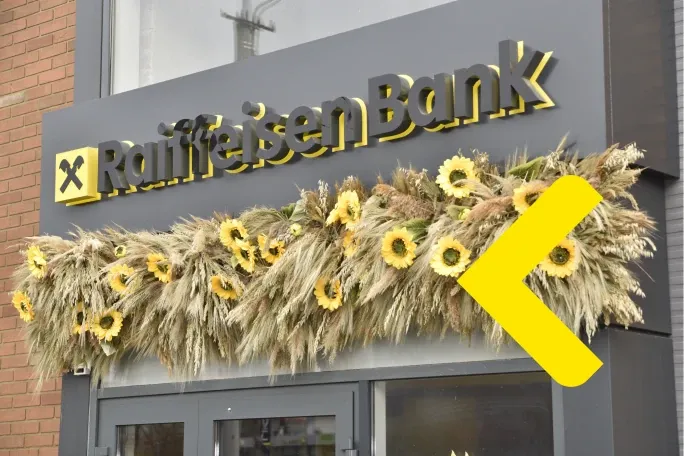
Raiffeisen Bank asked a court to seize 100% of the corporate rights of the Nibulon agroholding and the property of its owner Andriy Vadatursky, up to $43.5 million. The court returned the application over a procedural error, so the bank can file it again while farmers are already bracing for bankruptcies.
A bank sues a borrower who pays badly, and there is nothing strange about that. It becomes strange when a creditor that itself agreed to a deferral for the debtor asks to freeze the debtor's entire business. That is exactly what the Ukrainian Raiffeisen Bank did in November with the Nibulon agroholding, one of the largest grain exporters in Ukraine. It happened at a moment when farmers are losing exports because of strikes on ports, and Nibulon's owner is forecasting the first wave of bankruptcies in the industry.
Political analyst Oleksiy Holobutsky called this attempt a raid in Russia's interests. His main argument concerns the bank's owner. The Austrian group Raiffeisen Bank International, which owns the Ukrainian Raiffeisen Bank, still has a subsidiary bank in Russia. To understand whether the application is an ordinary debt collection or something more, we need to go through what exactly the bank asked for, where the debt came from and what the court answered.
What the bank asked for
The bank applied to the Commercial Court of Kyiv before it had even filed the lawsuit itself. Such a document is called an application for securing a claim. The creditor asks to seize the debtor's property in advance so that the debtor cannot sell it or transfer it to someone else while the trial is under way.
The list turned out to be broad. The bank asked to seize Andriy Vadatursky's 100% stake in LLC "SP "Nibulon"" and his 100% stake in the Nibulon shipbuilding and ship repair plant. In addition there were 2 residential houses, several plots of land and the money in Vadatursky's personal accounts. The overall limit of the seizure was $43.5 million, or UAH 1.95 billion.
Imagine what such a seizure would mean for a company that buys grain from thousands of farmers every day and ships it abroad. The owner would not be able to dispose of any stake in either enterprise. For other creditors, and for the farmers who sell their harvest to Nibulon, it would be a signal that the company might not survive the coming months.
What the court decided
On 24 November, judge Volodymyr Lomaka returned the application to the bank. The reason is procedural: the bank did not offer counter-security, which Article 139 of the Commercial Procedure Code requires. Counter-security is a guarantee from the party that asks for the seizure. It covers the other party's losses if the seizure later turns out to have been groundless.
So the court did not reject the bank's claim, although that is how the first reports put it and how Holobutsky presented it. There is no lawsuit yet. The court did not assess whether the debt exists or whether the bank is right; it only pointed to the missing guarantee. The ruling in case No. 910/15015/26 can be appealed within 10 days, and the bank can file a corrected application again at any time.
Where the debt comes from
Nibulon entered the full-scale war with $570 million in loans from 26 banks and financial institutions. The company lost part of its terminals, fleet and land, so it could not pay on the old schedule. Andriy Vadatursky, who took over the company after a Russian missile killed his father in 2022, chose negotiations with creditors over bankruptcy. Restructuring agreements were signed by the EBRD, the European Investment Bank, IFC, a syndicate of foreign banks led by ING and Crédit Agricole, Ukreximbank, Oschadbank and Sense Bank.
Raiffeisen Bank was on that list too. In 2024 it and Nibulon signed a bilateral agreement under which a $45 million loan was stretched over 6 years. The sum that the bank has now asked to seize almost matches it. However, neither the bank nor the court has publicly explained which debt exactly is at issue.
Restructuring did not remove the problem. Nibulon's financial director Mykola Hrubov said that because of the blocked terminal and fleet in Mykolaiv, the company directs almost all its free money to paying interest. That is why Nibulon hired a financial adviser and is looking for a new model of servicing the debt. In the summer Vadatursky gave the figures. Over 4 years of war the company earned $241 million of operating profit before interest, taxes, depreciation and amortization (EBITDA), and paid $234 million of it to the banks. In other words, almost everything Nibulon earned went to creditors.
So there is a mundane explanation for this story. The creditor sees that the borrower barely manages to pay interest and wants to secure its money while there is still something to seize. That is the bank's lawful right. What is unclear is something else: why, of Nibulon's more than 25 creditors, it was Raiffeisen Bank that decided to act alone, outside the common arrangements. In response, Nibulon said that it is working as usual, buying, shipping and exporting grain. The company invited the bank to return to restructuring together with the other creditors.
Interestingly, shortly before this, Raiffeisen Bank's management board chair Nataliia Hurina spoke about farmers in very different words. In an interview she said "We are all in the same boat" and called the agricultural sector the first to be hit by the attacks on ports. For companies that survived shelling and lost turnover, she considered additional working capital financing the only right way out. An application to seize 100% of the business of one such farmer fits poorly with those words.
An industry on the brink
Holobutsky builds his argument about "perfect timing" on the state of the industry, and here the figures are on his side. In its October Inflation Report, the National Bank estimated that because of the blocked sea routes, farmers will fall short by about $4.6 billion of export revenue in the second half of 2026. This is money that should have come to farmers and traders for grain but will not, because the grain could not be shipped out.
In November, large processors began stopping one after another. Kernel halted all its oil extraction plants, on 12 November Delta Wilmar Ukraine stopped production, and on 13 November Korolivskyi Smak announced a stoppage. The companies explain this by power outages after Russian strikes on the energy system and by the threat of shelling for workers.
The figure of 262 agricultural companies closed in January-August 2026, often cited as proof of the crisis, proves little by itself. In the same period 853 new agricultural companies were registered in Ukraine. Profit is a better indicator of the crisis. The combined net profit of agricultural companies in the first half-year fell by 19%, although revenue over the same period grew by the same 19%. That is, farmers sell more but earn less.
On 23 November, in an interview with foreign journalists, Vadatursky warned that the first bankruptcies of agricultural enterprises are expected as early as spring. According to him, unsold grain is pushing prices down, banks are reluctant to lend to the industry, and Nibulon itself exports half as much as before the invasion. Because of the war, 68% of the company's assets cannot work at full capacity, and Vadatursky estimated the direct losses from Russian strikes at $580 million. The court issued the ruling returning the bank's application the day after this interview. When exactly the bank filed the application is not stated in public reports.
Whose bank it is
The Ukrainian Raiffeisen Bank is a separate legal entity but belongs to the Austrian group Raiffeisen Bank International. The same group also owns the Russian JSC Raiffeisenbank, which after the start of the invasion remained the largest Western bank operating in Russia. For years the group has been declaring that it wants to leave the Russian market. However, selling the Russian subsidiary requires the consent of a government commission and Putin's signature.
The Russian subsidiary earns very large money for the group. In the first 9 months of 2024 it made more than $1 billion in net profit, almost half the profit of the whole group. In the same period it paid €227 million in taxes to the Russian budget.
There are also benefits for Russian soldiers in this story. Since 2022, Russian law has obliged banks to grant payment holidays to the mobilized and to contract soldiers, and the Russian Raiffeisenbank provides them. The law imposes this requirement on all banks in Russia, so the Austrians did not invent it, but they comply with it.
In October, investigative journalists established that at least 26 payments under Russia's state defense order passed through the Russian Raiffeisenbank in 2024-2025. The money moved along the supply chain of the company Qualitet, which sells lubricants to the Russian army. The total sum exceeded 15 million rubles, or about $180,000.
In September, the American company Grizzly Research, which makes money on falling share prices, published a report on customs records worth $1.19 billion linked to the Russian Raiffeisenbank. Among the goods were CNC machine tools, microchips, optical sights, components for tanks and equipment used in the production of ballistic missiles. Grizzly Research itself admits that customs records prove neither payments nor sanctions violations. Raiffeisen Bank International rejects these accusations and stresses that it complies with EU, US and British sanctions. After the report the group's shares fell by almost 10%.
It is against this background that Holobutsky puts his question. "The timing for a blow to Ukrainian agriculture was chosen perfectly," he believes, and he proposes that such cases be handled by the services responsible for state security. There is no direct evidence in open sources that the Ukrainian bank's decision was made in Moscow's interests. Still, the question of why a bank of the group through which payments for Russia's state defense order pass chose the worst possible moment for the industry to make such an application does not lose its meaning.
What next
The ruling of 24 November decided nothing finally. The court only pointed out the missing guarantee to the bank, and the bank can appeal the ruling or file a new application already with counter-security.
The next step will show what we are dealing with. If Raiffeisen Bank returns to joint restructuring, to which Nibulon is calling it, this will be an ordinary dispute between a creditor and a debtor. If, however, it comes to court again for 100% of the corporate rights of a company that ships out the grain of thousands of farmers, in the middle of a season when the industry is awaiting bankruptcies, the bank will have to explain its motives to more than just the court. There is no comment from Raiffeisen Bank in the reports on the case so far.
Source:Тарас Харченко
References:censor.netnovosti-n.orgmind.uaborgexpert.commind.uaukragroconsult.comkyivpost.comkurs.com.uathepage.uaepravda.com.uatheins.ruthemoscowtimes.comgulf-times.comforbes.ua