Sole verdict leaders: most bribery-convicted MPs are from Servant of the People
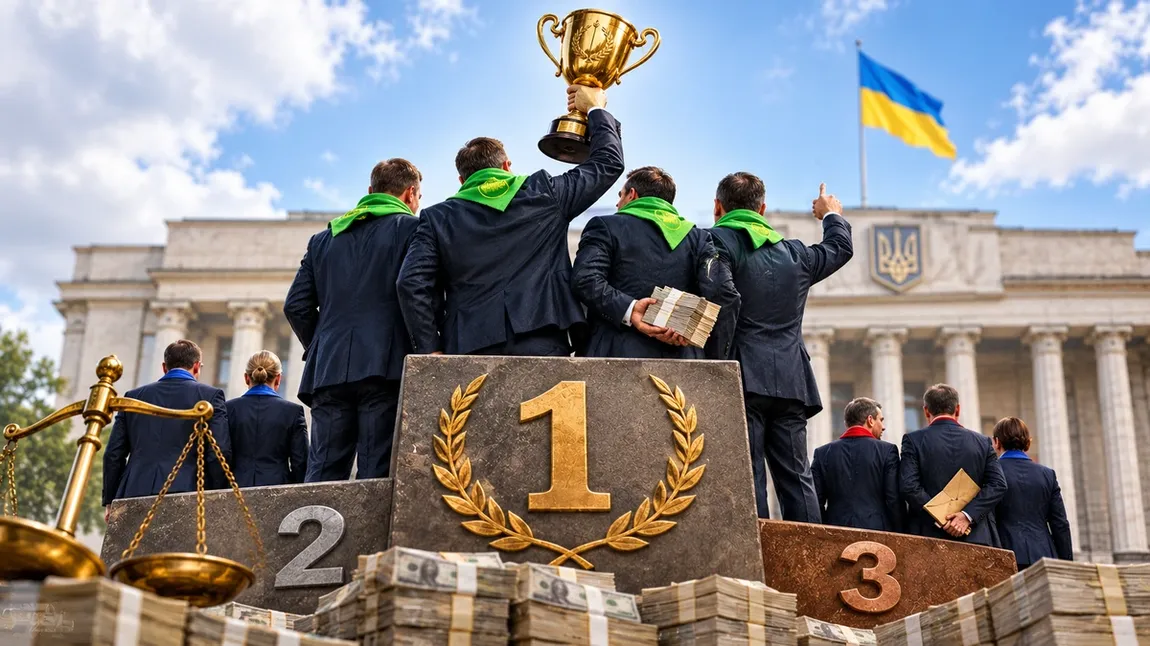
Absolute leadership for "Servant of the People": by the journalists' count, 100% of MPs of this convocation convicted of bribery belonged to the single-party majority
On 20 November 2026, the High Anti-Corruption Court sentenced Serhii Kuzminykh, an MP from "Servant of the People", to 3.5 years in prison for a kickback on the procurement of medical equipment for a hospital in the Zhytomyr region. The case itself is extremely petty: 558,000 hryvnias, a rate of 30% of the contract, and the phrase "even in tugriks, I don't care", which the MP tossed to a company representative on the eve of the handover of the money.
Kuzminykh became yet another MP from the presidential party with a prison sentence.
Can we already say that the most corrupt force in the current Verkhovna Rada turned out to be precisely the party that came to power in 2019 on a promise to put an end to corruption?
The answer to this question exists, and it is backed by figures. So let us look at who has appeared before the anti-corruption court, and how many times.
What do the figures show?
At the start of 2026, analysts at YouControl reviewed the rulings of the HACC and its Appeals Chamber and compiled a list of MPs of the 9th convocation who became defendants in criminal proceedings. There turned out to be 35 of them, 28 of whom were sitting MPs at the time. Of these 35, exactly 20 represented the "Servant of the People" faction: Volodymyr Hevko, Mykola Zadorozhnyi, Yurii Kamelchuk, Yurii Kisyel, Andrii Klochko, Anna Kolisnyk, Iryna Kormyshkina, Oleksii Kuznietsov, Serhii Kuzminykh, Mykhailo Laba, Oleksandr Marikovskyi, Lyudmyla Marchenko, Serhii Nahornyak, Ihor Nehulevskyi, Andrii Odarchenko, Maksym Pashkovskyi, Olha Saladukha, Mykola Solskyi, Oleksandr Trukhin and Margaryta Shol. All the other factions and groups combined accounted for 15 MPs:
- 4 from the "For the Future" Party: Yaroslav Dubnevych, Iryna Konstankevych, Serhii Labaziuk and Anna Skorokhod,
- 3 from the "Restoration of Ukraine" group: Anatolii Hunko, Dmytro Isaienko and Oleksandr Yurchenko,
- 2 each from "European Solidarity" (Artur Herasymov and Mykhailo Zabrodskyi), "Fatherland" (Mykhailo Volynets and Yulia Tymoshenko) and "Trust" (Robert Horvat and Serhii Shakhov),
- 1 non-affiliated: Viktor Bondar,
- 1 from the former OPZZh: Andrii Derkach.
Even these 20 understate the real share of the presidential party. YouControl put Oleksandr Yurchenko and Anatolii Hunko in the "Restoration of Ukraine" group, although both entered the Rada from "Servant of the People" and only later moved to that group. The analysts counted Anna Skorokhod under "For the Future", although she too got into the Rada from "Servant of the People" and was expelled from the faction back in 2019. Taking these three deputies into account, there are already 23 "Servant of the People" members on the list of 35, that is, two out of every three.
It is easy to make a mistake here and explain everything with simple arithmetic. In 2019, "Servant of the People" won 254 seats, roughly 60% of parliament. The largest faction logically produces the most defendants, just as the largest city produces the most road accidents. This explanation is worth checking before looking for more complicated ones.
The check shows that arithmetic explains the number of cases, but not their weight. A significant share of the cases against MPs from other factions concerned false declarations. The penalty under that article is a fine, and the statute of limitations on it is short. According to YouControl, 10 such cases were closed precisely because the limitation period had expired. That is how the cases of Artur Herasymov of "European Solidarity" and Iryna Konstankevych of "For the Future" ended, for example: the court found that the declarations were false, but released them from punishment.
With real sentences the picture is completely different. For bribes and influence peddling, prison terms in this convocation went to Andrii Odarchenko, Anatolii Hunko, Lyudmyla Marchenko, Oleksandr Yurchenko, and now Serhii Kuzminykh. All five came to the Rada from "Servant of the People". Two more "servants", Oleksandr Trukhin and Iryna Kormyshkina, struck plea deals with the investigation, that is, admitted their guilt, and received a fine and a suspended sentence. Among MPs from other factions, only Andrii Derkach of the former OPZZh received a prison sentence from the HACC this year. He was sentenced in absentia to 15 years for high treason and illicit enrichment, that is, as a Russian agent, not as an MP who took kickbacks. So in the category of classic corruption, where an MP sells his influence for money, the presidential party is a monopolist.
What "servants" get jailed for
What exactly did the "servants of the people" put up for sale? Odarchenko tried to bribe the head of the Restoration Agency, Mustafa Nayyem, with bitcoins so that he would allocate money to a university the MP himself controlled. In November 2024, the HACC gave him 8 years in absentia, because Odarchenko had already fled across the Romanian border in September.
Hunko took 85,000 dollars for a promise to help with the state lands of the National Academy of Agrarian Sciences. The first instance gave him 7 years; in February 2026 the appeal reduced the term to 4 years, and the MP was taken into custody right in the courtroom.
Marchenko sold men exit from the country through the "Shliakh" system, and when detectives arrived, she threw dollars over the fence. On 13 November 2026, the appeal left her with 2 years of imprisonment, and the MP was also arrested in the courtroom. Yurchenko, according to the prosecution, demanded 13,000 dollars for the necessary amendments to a bill, with another 200,000 to go to members of the relevant committee. In September 2026, he received 9 years with confiscation of property, a record for MPs of the 9th convocation. The case reached court back in 2021, so the verdict took 5 years.
Against this background Kuzminykh stands out in nothing except style. The court spent almost 4 years on his case, because the MP and his lawyers systematically failed to show up at hearings: as of July 2025, the defence had disrupted 31 hearings out of 86. Now he promises to appeal the verdict and prove his innocence, and until the verdict enters into legal force he is sitting at home with an electronic bracelet.
When all this happened matters. Marchenko traded in the exit of men of conscription age during the war. Kuzminykh took a kickback on medical equipment a month before the full-scale invasion. Another "servant", Oleksii Kuznietsov, was served a notice of suspicion in August 2025 in the case of the procurement of drones and electronic warfare systems for the National Guard at inflated prices. The investigation claims that participants in the scheme took kickbacks of up to 30%, and that on a single contract for EW systems worth 5 million hryvnias Kuznietsov and his accomplices split 1.5 million. That is, we are talking about money that was supposed to go to defending the homeland from Russian invaders.
Envelopes in the office of the faction's deputy head
Individual verdicts could still be written off as the work of random people who happened to get into the Rada on the wave of Zelenskyi's popularity. The envelope case destroys that version too. On 27 December 2025, NABU and the SAP announced notices of suspicion to five MPs from "Servant of the People": Yurii Kisyel, Yevhen Pyvovarov, Ihor Nehulevskyi, Mykhailo Laba and Olha Savchenko. According to the investigation, since 2021 they had acted as an organised group and received money for "necessary" votes in the Rada.
The scheme described by the investigation had clear rules. A coordinator sent bill numbers and instructions on how to vote to a closed WhatsApp chat. The size of the payment depended on whether the MP was in the chamber and how many of the required decisions he supported. The sums, according to the investigation, ranged from 2,000 to 20,000 dollars. One of the MPs received at least 145,000 dollars in November and December 2025 alone, which were then distributed among the other participants.
The main name in this case belongs to no rank-and-file MP. Yurii Kisyel heads the Rada's transport committee and is deputy head of the "Servant of the People" faction, that is, the person responsible for the faction's discipline during votes. The HACC set his bail at 40 million hryvnias. Kisyel himself denies guilt. However, if the investigation's version is confirmed in court, it will turn out that corruption in the faction was not the business of individual MPs. It was built into the mechanism by which the faction passed laws.
What next?
And now we can answer the question with which it all began. By the number of defendants, "Servant of the People" outstrips all the other factions combined. By the gravity of the cases, it holds a monopoly on prison sentences for bribes. By the rank of the defendants, the case has reached the faction's leadership. The size of the faction explains the first, but not the second and third. The second and third are explained by access: the single-party majority gained access to budget money, tenders, lands and votes, and some of its MPs treated that access as a commodity.
Meanwhile the queue to the courts is not getting shorter. The envelope case is only being prepared for trial; the cases of Kuznietsov, Klochko, Zadorozhnyi and former minister Solskyi are in court or at the stage of suspicion, and in June 2026 NABU and the SAP announced a notice of suspicion to Mykola Tyshchenko as well, who was also elected from "Servant of the People". In this row Kuzminykh is merely one more MP whose case has finally reached its end. If the courts keep working at the same pace, verdicts in the remaining cases will have to be awaited for 4-5 years each.
There will most likely be even more cases when the term of this Rada ends. Elections cannot be held under martial law, so the deputies elected in 2019 are still voting in the session hall, and their term just will not end. While they hold their mandates, a special procedure applies: a notice of suspicion to an MP can be signed only by the Prosecutor General. It was on this signature that cases against MPs got stuck for years. Formally, immunity was abolished as of 1 January 2020, but this special procedure is in essence a remnant of parliamentary immunity.
When the mandates run out, the "servants" will lose this immunity too. For NABU and the SAP they will become ordinary citizens, and detectives will no longer have to wait for the Prosecutor General to agree to sign a notice of suspicion. So verdicts against the "servants" are unlikely to end together with their parliamentary powers. Most likely, that is precisely when there will be many more of them.
So we wait for the spring announced in 2019 to finally arrive...
References:facebook.com