Oberih will get your data without you: what the new resolution means for men
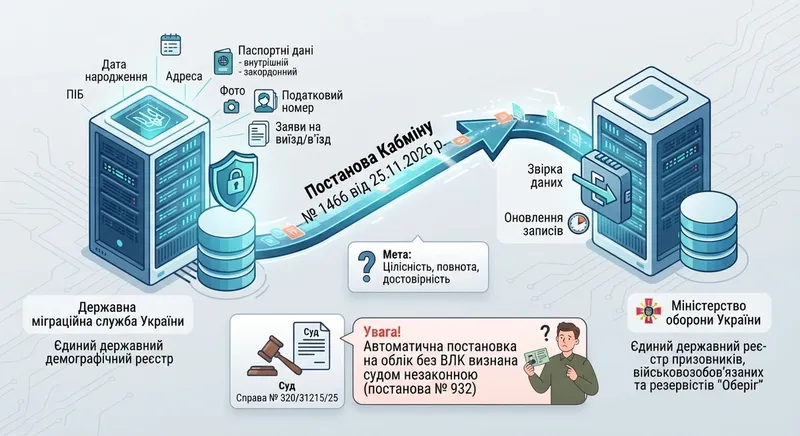
By Resolution No. 1466, the Cabinet instructed the Ministry of Defense to check the data of all men aged 17 to 60 in the migration service databases against the Oberih register. The military will receive foreign passports, emigration records and facial photos, even though a court has already found the previous automatic enrolment partly unlawful.
Once again the state is trying to find out how many men it has who must be placed on military record, and where they are now. On 25 November 2026 the Cabinet of Ministers adopted Resolution No. 1466, instructing the Ministry of Defense to check the data of all Ukrainian men aged 17 to 60 in the registers of the State Migration Service against the Unified State Register of Conscripts, Persons Liable for Military Service and Reservists, Oberih. Once the check is complete, the Ministry of Defense will have 120 calendar days to update the records in the register.
The official goal sounds technical: to ensure the "integrity, completeness and reliability" of the register's data. But behind this wording lies a very practical question. If the state has already connected other databases to Oberih several times, why is the data still incomplete, and what exactly will the military get now?
What the migration service will hand over
The list of data in the resolution is long. The migration service will pass to the Ministry of Defense information from its departmental system and from the Unified State Demographic Register. It includes the taxpayer number, if there is one, the record number in the demographic register, surname, first name and patronymic, date and place of birth, the address of the declared or registered place of residence, and information on citizenship.
Next come passport data. The military will receive the series and number, the date of issue, the issuing authority and the validity period of not only the internal passport but also the foreign one, as well as information on previous passports. Separately, the resolution mentions records of applications to leave abroad for permanent residence and to return to Ukraine. The last item is a digitised image of the face, that is, the passport photo.
It is these items that set the new check apart from the previous ones. The taxpayer number and address help find a person who has never been placed on record. The foreign passport, the application to leave for permanent residence and the photo make it possible to understand which men have been preparing documents for life abroad, and to recognise a person if his data is recorded differently in different databases.
All of this will be transmitted through secure communication channels, including removable media, that is, discs or flash drives. The part of the information that cannot be entered into Oberih will, under the resolution, be used only for verification.
A third database in 4 months
The new resolution is not the first in this series. As early as August 2024 the government launched an experiment in automatic verification of military records. At that time the Ministry of Defense explained that men aged 17 to 25 would be placed on record automatically as conscripts, including those who are abroad, and that the data of all men aged 16 to 60 would be checked against the databases of the migration service, the Ministry of Justice and the border guards. In 2025 the mechanism was extended to men aged 25 to 60 who had not previously been on record.
In the summer of 2026 the tax service was connected to Oberih. By Resolution No. 981 of 29 July the government obliged the State Tax Service to pass to the Ministry of Defense, within 90 days, data on men aged 18 to 60. The government explained that tax data should help find people who are not in the military register at all. That deadline expired at the end of October, and a month later the government turns to the migration service.
So in just 4 months the state has adopted 2 decisions on a mass check. The figures partly explain why. As of 2025, 6 million citizens had not updated their data in Oberih. The law gives 60 days for this, and missing the deadline without a valid reason carries a fine of 17,000 to 25,500 hryvnias, roughly $375 to $560. It seems the state was unable to make millions of people update their data themselves, so now it is collecting it from other registers.
What the court said about automatic enrolment
The large-scale check has a weak point, and a court has already spoken about it. The earlier experiment rested on Resolution No. 932 of 16 August 2024. It linked Oberih, through the Trembita system, with the migration service and the demographic register, and allowed men aged 25 to 60 to be placed on record without a military medical commission and without a personal visit. People who had earlier been taken off the record for health reasons also fell under this mechanism.
One of them, a man from the Luhansk region, underwent a military medical commission in February 2017, was found unfit and was removed from the record, which was written in his paper military ID. In May 2025 he saw in the Reserve+ app that he was on record again. At the territorial recruitment centre they explained that this was a consequence of Resolution No. 932.
The man went to court. In December 2025 the Kyiv District Administrative Court sided with the government, but the Sixth Administrative Court of Appeal overturned that decision in case No. 320/31215/25. It declared paragraphs 17 and 17-1 of Resolution No. 932 unlawful and invalid. The court explained that removal from the record for health reasons ends a person's obligations, and the law does not allow returning him to the record automatically without first cancelling the finding of unfitness. A delay by the recruitment centre in entering the data, in the court's view, gives no grounds to impose military obligations on a person again.
The decision entered into force on 16 September 2026. The court obliged the Cabinet to bring the resolution into line with the law and to create a mechanism to cancel the record of those placed on it under these paragraphs. The government filed a cassation appeal with the Supreme Court and asked to suspend the decision. Filing a cassation appeal does not in itself suspend a decision.
Two months later the government launches a new mass check. Judging by how the media retell Resolution No. 1466, it speaks of verifying and updating data, not of automatic enrolment. But it does not explain what will happen to a man who, as a result of the check, is found in the migration service database but not in Oberih, or whose data in the two registers do not match. Whether he will be placed on record automatically, as under Resolution No. 932, or summoned to the recruitment centre, is unclear from those retellings.
What this means for men
The check itself is not a summons to the recruitment centre and not a decision on mobilisation. The check takes place between agencies, and men do not need to go anywhere or resubmit documents. The 120 days apply to the Ministry of Defense, not to citizens.
The consequences, however, will be felt precisely by citizens. After the check, Oberih will contain up-to-date addresses, foreign passport data and photos. For a man abroad who prepared documents through the migration service, this means the state will know more precisely where he lives and whether he intended to return. For a man in Ukraine it means that an error in one register can pass to another, and he will have to correct it himself, as the man from the Luhansk region had to do through the court.
So Resolution No. 1466 closes one more gap in Oberih, to which the tax service and now the migration service have been connected within 4 months. The state gets data that lets it find and identify men of conscription age even abroad. But the rules by which this data turns into a military record have already been found unlawful by a court once, and the new resolution does not directly answer the question of what will happen to those whom the check finds for the first time. Until the government corrects Resolution No. 932 or waits for the Supreme Court's decision, every such entry in Oberih may become a new case in an administrative court.
References:censor.netdaily.com.uamukachevo.netnews.telegraf.com.uamod.gov.uafakty.com.uanews.finance.uaminfin.com.uakyivpost.com