Who pays for The Economist's 2027 crises: an Egyptian farmer, a US taxpayer, a pensioner
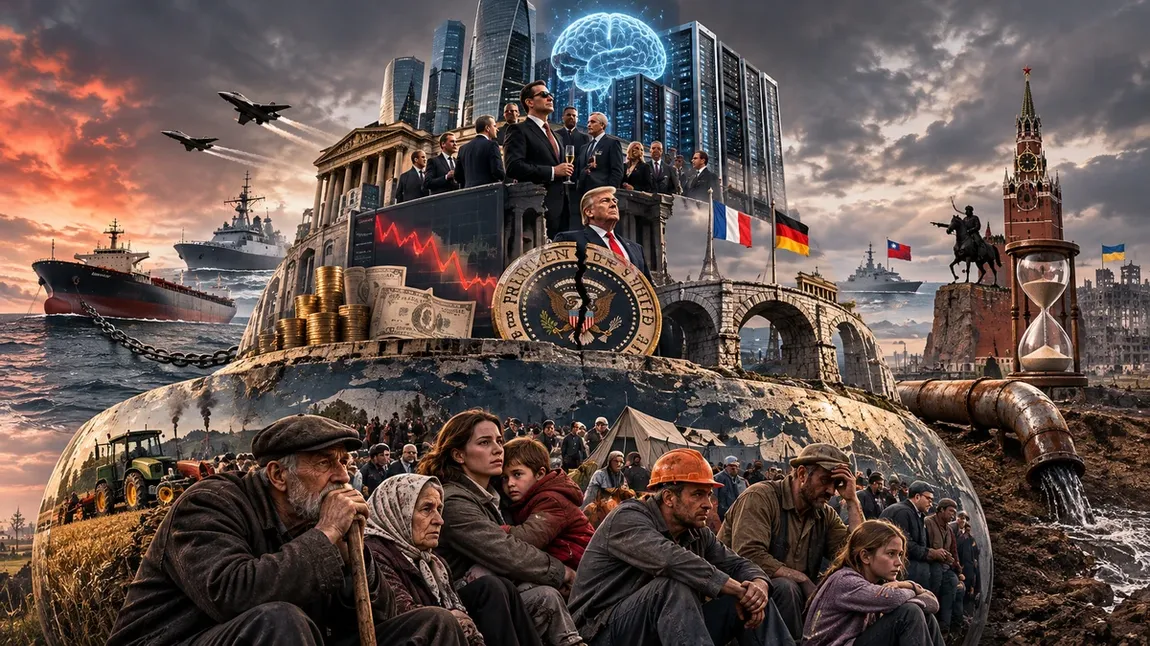
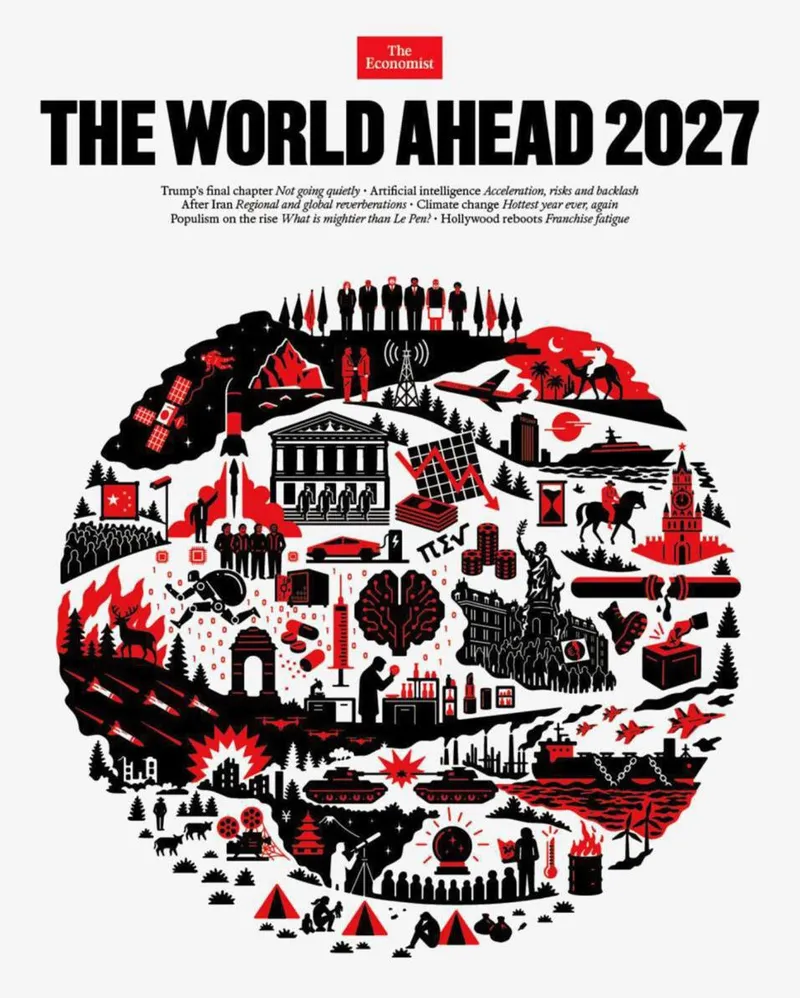
The Economist's annual forecast is usually read as a list of threats. In the issue for 2027 they are a war with Iran, the risk of a crash in the artificial intelligence market, the pressure of government debts, Trump's final years, Le Pen in France and Taiwan. Such a list answers the question of what may happen. It is silent on the question that matters more to most people: who will pay when it does?
The six risks from the cover of the new issue are examined in detail separately. Put them together, though, and a single chain appears. The price of decisions made in Washington passes from hand to hand until it reaches people who made none of those decisions. In the forecast for 2027 there are at least three such people: a farmer in Egypt, an American taxpayer and a pensioner whose savings sit in a fund.
Where this price comes from
The first key to the answer was given by the Italian economist Giovanni Arrighi. He showed that every state that became the center of world capital, from Genoa to Britain, moved money from production into finance at the peak of its wealth. Earning on loans and bonds became more profitable than building factories. Arrighi saw such a turn as a sign that the center was already weakening, even though it had more money than ever. The United States has been in this phase since the 1970s, when the dollar was cut loose from gold, and after the financial crisis of 2008 it became deeper.
Arrighi explains what happens to such a center. Why its weakness drags on for decades, and why others pay for it, is explained by the concept set out in the book "Ekonomika zbytkiv" (in English, "The Economics of Losses"). It rests on the observation that the state removes risks from big private capital and shifts them onto society. Profits stay in private hands, losses are spread among everyone. The most convenient way to do this is through war, because it is practically impossible to verify how much it really cost and who received the money.
The Economist's forecast lets us trace this mechanism through three specific people.
The farmer who did not vote in Washington
The first in the chain lives thousands of kilometers from Washington. Imagine an Egyptian farmer who has to buy fertilizer in the spring. At the end of February, because of the war with Iran, the Strait of Hormuz closed. Not only tankers with oil and gas pass through it, but also a considerable share of the world's fertilizers. The FAO warned that delays in deliveries would cut harvests, because fertilizer is applied in a particular week of the season, not whenever it finally arrives.
The farmer buys less fertilizer and pays more for it. In the autumn he harvests less grain, and bread in Cairo gets more expensive. This person did not elect the American president, did not decide whether to bomb Iran, and had no influence on any decision that closed the strait. Yet he has already paid part of the price of this war.
Meanwhile, others made money on the same war. In October Brent crude averaged 124 dollars a barrel, and oil companies received windfall profits. Arms makers received new orders. In early November Brent fell 16% in a week because traders believed in a deal with Tehran. For the stock exchange that is good news. For the farmer it came a whole season too late.
The taxpayer who services other people's debts
The second in the chain lives in the United States itself. Expensive oil pushed up inflation, and the Federal Reserve, from which a rate cut had been expected at the start of the year, raised its rate in September. It was the first increase since 2023. In November Fed officials are already discussing whether to raise it even faster. For an American this means a costlier mortgage, a costlier car loan and bigger credit card payments.
The state also borrows at a higher price. The OECD estimates that in 2026 the world's governments and companies will borrow a record 29 trillion dollars in the bond markets. Of what OECD governments borrow this year, 78% will go to repaying earlier debts. In other words, states mostly borrow to pay for what they have already borrowed.
The interest on these loans is paid out of taxes. For the bondholder it is a reliable income, guaranteed by the state. For the taxpayer it is an expense he did not agree to and cannot cut. Arrighi would see here the ordinary picture of the financial phase, when money is made on debts rather than on production. The economics of losses shows who actually pays that interest.
The pensioner who was sold someone else's risk
The third in the chain may not even know he is taking part in the artificial intelligence boom. American capital is looking for somewhere to put its accumulated money, and it has found data centers. They are built mostly with borrowed funds. Tom Standage, deputy editor of The Economist, warns in his forecast that companies are taking on ever more complex and opaque debts, so the risk of a sharp crash is growing.
While shares are rising, the profit goes to the founders of technology companies and to investment funds. At the same time banks are already selling the loans issued for building data centers. They are bought by private credit funds, pension funds and insurance companies. The risk that a bank does not want to hold on its balance sheet passes to people who are saving for old age or insuring their future.
If the bubble bursts, the scenario is known from 2008. Then devalued mortgage securities were declared a threat to the whole system, and their holders were rescued with public money. This time data centers may take the place of mortgage securities. The pensioner will lose part of his savings as an investor, and then pay again for the rescue as a taxpayer.
Ukraine, which the forecast does not mention
In The Economist's top ten themes for 2027 there is no Russia's war against Ukraine. The simplest explanation is that the ten consists of new trends, and this war is no longer new.
The economics of losses offers another explanation. A war whose costs nobody intends to audit in full eventually stops being news and becomes background. It is mentioned when its price has to be discussed or spending cut. The US, meanwhile, gains economically from it: it sells Europe weapons for Ukraine and supplies it with gas instead of Russian gas. This does not mean that Washington drags out the war for profit. But not all participants necessarily want to cut these gains.
So Ukraine stands in the same row as the farmer, the taxpayer and the pensioner. It pays with a war to which the world is gradually growing accustomed.
Who wins
Reviews of The Economist's forecast advise business to prepare in advance for a turbulent year. The best prepared will turn out to be those who stand closest to government decisions, and planning changes little here. They are the ones with access to the mechanisms that let them keep the profits and spread the losses among everyone else.
The farmer in Egypt, the American taxpayer and the pensioner have no such access. So as long as the price of Washington's decisions can be passed on to them, Washington has no reason to change those decisions.
If you found this piece interesting, you may also be interested in my books: "The Economics of Losses," available in English and Ukrainian, and "Russkiy Mif," which you can read in English and Ukrainian.
References:femida.ua