Silence Until Victory 2.0: What Is Behind the New Restrictions on Journalists
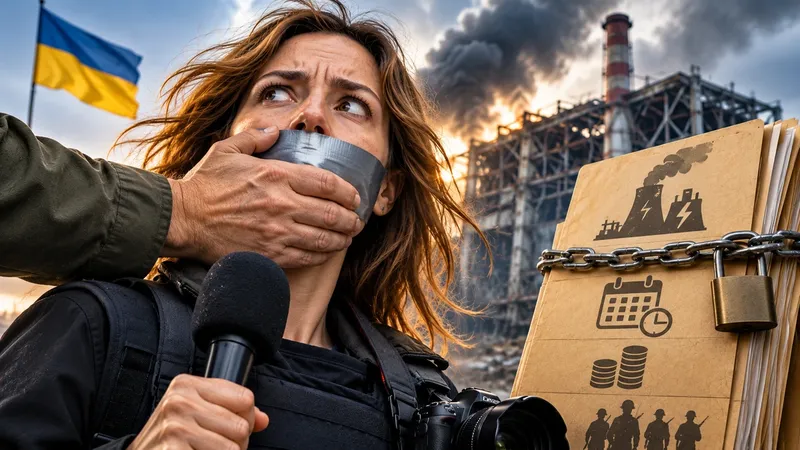
President Zelensky has instructed the government to restrict media publications about the consequences of Russian strikes on energy facilities, the timelines for their restoration, and the construction of protective structures. The authorities explain this as a matter of security, but past experience shows that restricting access to information often deprives society of control over state spending and creates favourable conditions for corruption.
The NSDC wants to restrict the media's right to report on the repair of energy facilities in a country where journalistic investigations and NABU are often almost the only mechanisms for exposing corruption.
On 28 November, Ukraine's President Volodymyr Zelensky enacted a decision of the National Security and Defense Council on protecting critical infrastructure during the 2026/27 heating season. One of its points instructs the government to ban the media from reporting on the consequences of strikes on critical infrastructure facilities, on the timelines for their restoration, and on how protective structures are being built at energy enterprises.
Security is an entirely understandable argument for restricting operational information. But it cannot serve as a universal justification for informational secrecy. Ukrainians who are left without electricity have the right to know what is happening with the energy infrastructure, when it will be restored, how much it costs and who is responsible for the work. Russian headquarters do not necessarily need to know the operational details. But Ukrainian society cannot be denied control over how public funds are used and how the authorities work.
To understand who the new ban will really harm, it is enough to look at how the previous ones worked. In almost five years of full-scale war, the state has introduced at least five such restrictions: it closed data on the dead, officials' declarations, parliamentary sessions, exchange rates at currency exchange offices, and defence procurement. In each case one can look at what exactly changed after the ban and who, as a result, lost access to information.
What exactly will be banned and who will enforce it
The president's communications adviser Dmytro Lytvyn explained that the specific measures will be determined by the government and the Security Service of Ukraine. According to Mr Lytvyn, the task is complicated by the fact that most of the reports and footage from strike sites are published by anonymous Telegram channels.
The motive for the ban is clear. If, after a strike on a substation, the news reports what exactly has been destroyed and in how many days it will be fixed, the Russian military gets an assessment of its strike and a date by which it is worth striking again.
At the same time, a similar restriction has been in force in Ukraine since March 2022. Order No. 73 of the Commander-in-Chief of the Armed Forces allows showing the consequences of strikes on military facilities after 12 hours. In other words, until now the state demanded a delay from journalists, whereas the new point speaks of a ban whose duration is not specified.
The second half of the point concerns not strikes but budget money. The same NSDC decision obliges the Recovery Agency, local administrations and infrastructure operators to complete the engineering protection of energy facilities within a month. The media will not be able to write about the stage this construction has reached. So whether the protection was built on time, or built at all, will be known only to those who build it and the officials who inspect them.
The weak point of the ban was named by Mr Lytvyn himself. It will reach registered newsrooms, which have an address and answer before the law. Anonymous channels, where this footage mostly comes from, will not be affected by it.
The dead: a secret binding on everyone except…
How many Ukrainian soldiers have died in this war is known only to a narrow circle of officials. In 2022 the Ministry of Defence declared that this data is a state secret. The then deputy minister Hanna Malyar explained that the enemy uses the numbers of killed and wounded to calculate the Ukrainian army's further actions. The people with access to these figures, she said, have been warned about criminal liability for disclosure.
The explanation itself is hard to argue with. The only question is whether a state secret can be part of a politician's interview. In February 2026 Zelensky unexpectedly told a French TV channel that 55,000 Ukrainian soldiers had been killed on the battlefield since the start of the war. On 31 July, in an interview with the American channel Fox News, he first estimated Russian losses at 700,000 killed, and then named the number of Ukrainian soldiers killed: "about 50,000". Before that the president said he did not want to be too candid, because the Russians would understand what is happening with the Ukrainian army.
The number of the dead cannot, a priori, drop by 5,000 in half a year of war. So at least one of the two figures is inaccurate. Nobody will be able to find out which one, because for everyone this data is closed under threat of prison.
It turns out that a secret that is binding on every officer and every journalist ceases to be binding in certain circumstances. The president discloses it when he considers it necessary. And the fact that the number of the dead changes depending on the interlocutor does credit to no one. Ukrainians know this manner of communicating with the press well from the speeches of Putin's spokesman Dmitry Peskov, and for the president of a country at war this comparison is no credit.
Why were the declarations classified?
In a declaration, an official reports to the state once a year, in writing, what he and his family own. With it, the National Agency on Corruption Prevention can compare an official's salary with his house and car.
On 24 February 2022 the NACP closed the public part of the declarations register so that the enemy could not obtain data on Ukrainian civil servants. This decision probably made sense: a declaration lists a person's address, family and property.
But that is not all. On 4 March the Verkhovna Rada allowed officials not to file declarations at all until the end of martial law. There is a fundamental difference between these two decisions. A declaration filed to a closed register will not be seen by Russian intelligence, but it will be seen by the NACP. To protect people from the enemy, it was enough to close the register. Abolishing the reporting itself protected no one from the enemy. It freed officials from the oversight of important anti-corruption bodies of the state.
It was in 2022 that the contracts for feeding the army were signed, under which suppliers, according to NABU, received over 733 million hryvnias of unjustified profit. That same year detectives were looking in Zaporizhzhia for missing humanitarian aid. In those months officials controlled enormous flows of budget money and international aid, and in those very months they did not have to report on their own assets.
Nobody was in a hurry to restore reporting. In September 2023 parliament resumed declaring, but decided to keep the declarations themselves closed for another year. A petition to the president demanding that he veto this law collected the required 25,000 signatures in only three hours. After that Zelensky vetoed it, and in December 2023 the register was finally opened.
In effect, for almost 22 months the country lived without full public control over the assets of the people who run it. And this control was restored not thanks to a decision of the authorities but under pressure from citizens.
But even after the register was opened, exceptions remained. In particular, the right not to file declarations until the end of martial law was kept for servicemen of the Security Service of Ukraine.
In November 2026, as part of the operation "Carthage", NABU exposed senior SBU officials. After that the president submitted a bill that restores the duty to declare for SBU and intelligence employees who are not fighting at the front. He explained the reason for this decision in his own words: "so that their way of life and everything they have are available for checks and accountability."
And here a perfectly natural question arises: if declarations are needed to check officials' way of life and hold them accountable, why was this not remembered back in 2022?
After all, closing the register did not protect soldiers at the front. Their declarations could have been closed regardless of whether the rest of society had access to the register. The restriction, instead, shielded from public scrutiny the way of life of those who stayed in their offices.
Now the authorities themselves in effect admit that the absence of such control was a problem. But it took almost four years and eight months, and a NABU investigation, which again raised the question of what is going on behind closed doors.
Broadcasts of the Rada: security that never existed
Live broadcasts of Verkhovna Rada sessions were stopped in February 2022. Even at the end of July 2025, the parliamentary speaker Ruslan Stefanchuk explained this by security considerations. In the first months of the full-scale war the Rada also stopped publishing its agendas and session transcripts.
But here a simple question arises: what exactly does a switched-off broadcast protect against? The address of the Verkhovna Rada is on every map. Russian military personnel do not need the "Rada" TV channel to find the building under the dome on Hrushevskoho Street. The very fact of a broadcast has no effect on whether the enemy can determine where parliament is located.
The only thing that could theoretically be hidden is the time the sessions are held. But that was no secret either: throughout all these years individual deputies themselves went live from the session hall on their social networks.
So switching off the broadcasts gave society no additional security guarantees, but it had a quite concrete consequence: voters stopped seeing how parliament works, what their deputies say and how they vote. Citizens learned about the work of the Verkhovna Rada mostly from the phones of individual politicians, each of whom showed only what he considered necessary.
The consequences of such secrecy were especially visible on 22 July 2025. That day 263 deputies voted for a law that stripped NABU and the Specialized Anti-Corruption Prosecutor's Office of their independence. The president signed it the same day. That evening protests began in Kyiv and other cities. By 31 July parliament had returned their powers to the anti-corruption bodies.
Yaroslav Yurchyshyn, chair of the parliamentary committee on freedom of speech, directly linked that vote to the closed-door regime of parliament: "Why the broadcasts have still not been restored, we saw on 22 July, during the vote against NABU and SAPO." According to him, in a half-closed mode some deputies begin to think they can with impunity disregard what people fought for during the Revolution of Dignity.
On 16 September 2025, about a month and a half after the protests, live broadcasts were restored. The resolution named a change in the security situation as the reason.
But in September 2025 Russian missiles reached Kyiv just as they had before. Neither the location of the Verkhovna Rada nor the nature of the Russian threats had fundamentally changed in the meantime. Something else had changed: people took to the streets and forced the authorities to reckon with their opinion.
Exchange office boards: the rate went up, the numbers vanished
The decision on exchange rates was made by the National Bank, not the president, and it is not directly connected with corruption. But this story illustrates another problem well: when the authorities cannot cope with a particular situation, they often try simply to remove information about it from view.
On 21 July 2022 the NBU raised the official dollar rate from 29.25 to 36.57 hryvnias. Over the following week the cash dollar rose to 41 hryvnias in banks and to 42.2 hryvnias on the black market.
On 29 July the National Bank banned non-bank exchange offices from displaying boards with currency rates on the streets. The regulator explained this by saying that exchange offices were artificially inflating the rate. However, financial analyst Mykhailo Demkiv noted at the time that there was no evidence of a speculative nature of this rate.
One argument can be made in favour of the NBU's decision: in the first days of August 2022 the cash dollar really began to get cheaper. But this did not strengthen the hryvnia for long. As of 28 November 2026 the official dollar rate stands at 45.11 hryvnias, and in Kyiv exchange offices it is sold for about 45.35 hryvnias. The rate is influenced by the war, the state of the budget and the volume of international aid, not by the numbers on street boards.
Yet the ban has not gone anywhere, although the currency panic of 2022 passed long ago. What is more, the rules for market participants remained different: banks are allowed to display rates on their facades, while non-bank exchange offices are not.
As a result, a person who wants to buy currency can no longer simply walk down the street and compare offers. To find out the rate, one has to go into exchange offices one by one. This did not solve the problem with the rate. The information about it was simply removed from the streets.
"Keep quiet until victory": what silence would have cost
On 21 January 2023 journalist Yurii Nikolov published a Ministry of Defence contract for feeding soldiers in 6 rear-area regions worth more than 13 billion hryvnias. Among the prices were eggs at 17 hryvnias apiece. The ministry at first rejected the data about inflated prices.
In October 2023 Yuliia Mostova, editor-in-chief of ZN.UA, said that after that publication the president, at an off-the-record meeting, asked editors not to write about corruption until victory. Ms Mostova herself was not at the meeting and relayed this from her colleagues. According to her, the editorial offices would have agreed if the president had asked for a week to respond before each publication, but there was no such proposal. No public response from the Office of the President to these words could be found.
The argument in favour of such a request is well known. Every corruption scandal in a country at war is used by Russian propaganda, and it becomes harder for allies to explain to their voters why they should give money to Ukraine.
Whether silence would have saved Ukraine can be calculated. A little over a month after the publication the ministry made public new contracts with lower prices. According to NABU, which sent this case to court on 12 November 2026, after the investigation began the suppliers lowered prices on 11 products, and the budget did not spend 788 million hryvnias. The state rear-services operator created after the scandal saved 17 billion hryvnias out of 75 billion in 2024, according to then Defence Minister Rustem Umerov.
There is an objection in this story too. Tetiana Nikolaienko, a member of the anti-corruption council at the Ministry of Defence, stated in 2024 that there is no confirmation of eggs actually being bought at exactly 17 hryvnias, because the additional agreement set the price at 9 hryvnias. Yet the prices were lowered after the publication, not before it. Had the editorial offices kept quiet until victory, the 13-billion contract would have been carried out at the original prices, and the money the army lacks would have gone to the suppliers. Silence would have saved not Ukraine, but those who were making money off it.
Defence procurement: closed, but…
On 5 July 2024 the government allowed information about defence procurement not to be made public and the settlement where an enterprise is located not to be indicated in documents. The Ministry of Economy explained this by saying that such a step would make it harder for the enemy to find defence plants.
The first question about this decision is why it was adopted precisely then. If open tenders made it possible to establish where a plant or workshop working for the army was located, such information should have been hidden even before the full-scale invasion. After all, Russia had already been fighting against Ukraine in Donbas for eight years. Instead, the government took this up only in the third year of the big war, when Russian missiles had already struck defence enterprises many times.
The second question is whether this ban helped at all. Analysts at YouControl analysed 7,362 reports by the SBU itself for the period from January 2020 to August 2026. They found 269 reports about spotters who corrected Russian strikes, and 43 cases in which agents personally filmed the grounds of defence enterprises. By contrast, they found not a single case in those reports in which the enemy learned the location of a defence facility from a public register.
That is, the Russians obtained information about defence enterprises through recruited agents, not from Prozorro. Strikes on enterprises did not stop after July 2024. So closing procurement did not eliminate the main channel of information leakage, which the SBU's own materials pointed to.
But together with the addresses of enterprises, the prices and contracts, which in themselves are not a military secret, also disappeared from open access. Vitalii Shabunin, head of the Anti-Corruption Action Centre, drew attention to two important details of the government resolution: a contract must be uploaded to the Prozorro system within ten days, but no liability is provided for failing to meet this requirement. And it is allowed to be made public only 90 days after the end of martial law.
Journalist Oleh Onysko drew attention to one more detail: even the cost of materials for building fortifications became closed. But the price of a cubic metre of concrete does not tell the Russian army where a fortification is located. It allows Ukrainian citizens to find out how much the state pays for this concrete and who makes money on it.
And here is one more paradox that for some reason no one mentioned. Open and reliable data on defence procurement could do Russian propaganda far greater harm than any information campaign. It would show the real state of supply of the Ukrainian army, the scale of price inflation, of inefficient use of funds and of corruption in the defence sphere. After all, what could be more advantageous for the enemy than an army that is being profited from instead of being provided with everything it needs? Transparency of such spending would work for the country's defence capability no less than control over leaks of information about military facilities.
Corruption cannot be banned by a resolution; it has long been banned anyway by the Criminal Code. It can be made unprofitable and dangerous. A simple mechanism exists for this: the price of every state purchase must be open to society. It is precisely this mechanism that the government has in effect switched off.
And now the question remains: if closing procurement did not stop leaks of information to the enemy, but deprived society of the ability to monitor defence spending, who actually benefited from this decision? Was it really only about security, or did someone, under cover of it, gain the chance to profit from the war more calmly?
There are plenty to expose, no one to punish
When documents are closed to journalists, all that remains is to hope for state bodies. In Ukraine there are several: NABU, the Specialized Anti-Corruption Prosecutor's Office, the High Anti-Corruption Court, NACP, the police, the State Audit Service. How they cope is best told not by reports but by the fate of specific cases.
On 30 August 2022, NABU detectives together with SBU counterintelligence carried out more than 20 searches at the Zaporizhzhia Regional Military Administration, then headed by Oleksandr Starukh, at the city council, in warehouses and in officials' apartments. The investigation was checking where the humanitarian aid sent to the city by allies had gone. Yevhen Shevchenko, a freelance NABU agent, then stated that the case involved 22 sea containers, 389 railway cars and 220 trucks. Auditors established that 240,000 food packages had arrived at the administration, while documents confirming distribution to people exist for only 25,000. In December 2023, the case was transferred from NABU to the National Police. As of April 2026, it had no suspects, no indictment and no verdict. The officials whose offices were searched denied involvement or declined to comment on the case.
In the "Midas" case about kickbacks at Energoatom, the investigation names businessmen Tymur Mindich and Oleksandr Tsukerman as the organisers. Both are in Israel, where Mr Mindich, according to journalists, went a few hours before the search. Ukraine has sent an extradition request. Former minister Herman Halushchenko was released from the pretrial detention centre on bail of 150 million hryvnias, and the origin of that money has become the subject of a separate criminal case. Andriy Yermak, the former head of the Office of the President, was released on bail of 140 million. There is no verdict in this case.
In the army food procurement case, the court arrested the main suspect, the owner of the supplier companies, in absentia. As for the organiser of the network exposed within "Carthage", the president himself said that he had already started operating in Poland.
Over the course of its work, the Anti-Corruption Court has passed more than 350 verdicts, yet of the 42 cases involving members of parliament, only 7% ended in real prison terms. Those who go to prison are the executors. Those whom the investigation calls organisers are either abroad together with the money, or are waiting for trial at home after paying bail.
Meanwhile, the anti-corruption bodies themselves had to be defended on the street. In July 2025, parliament and the president stripped them of their independence in a single day, and it was only restored after protests. And the agencies that are supposed to protect state secrets are themselves becoming defendants in cases. In August 2026, NABU announced operation "Themis": according to the investigation, a group that included officials of the Office of the President and the Ministry of Justice used hackers to break into state registers and forge documents in order to seize other people's property. In November, within "Carthage", the investigation exposed senior SBU officials. Three weeks later, it was the SBU that was named among those who will decide what the media may not write about.
The president responded to each of these cases. After operation "Midas", he said that "there must be verdicts" and demanded the resignation of two ministers. After NABU and SAPO announced a suspicion against Iryna Mudra, deputy head of his Office, he dismissed her the same day. After operation "Carthage", he called what he had heard "frankly shameful" and promised personnel changes at the SBU.
But when the questions concern the president himself, the tone of the conversation changes.
In August, Zelensky stated that the anti-corruption bodies have "zero questions" for him. In late November, BBC correspondent Sarah Rainsford asked whether he knows who "Vova" is, the person mentioned on the recordings in the "Midas" case.
The president answered neither yes nor no. Instead he suggested that the journalist turn to the anti-corruption bodies: "You can ask the anti-corruption institutions. They have said publicly that they have no questions for me. I think that is the answer."
From a formal legal standpoint, such an answer is correct: a suspicion can be announced only when there are grounds for it, and NABU and SAPO have not announced one against the president. But the journalist was not asking about a suspicion or about Zelensky's procedural status. She was asking whether he knows a person named "Vova" who is mentioned by participants in the recordings.
These are different questions, and an answer to one does not replace an answer to the other.
All the more so because it was not merely a name in the conversations of the defendants. According to journalists, one of the houses discussed on the recordings was intended precisely for this person.
So the country heard that the anti-corruption bodies have no questions for the president. But it never heard an answer to the far simpler question from the journalist: does he know who "Vova" is.
What the ban will actually change
All the major corruption cases of the war years became public thanks to journalists and NABU. A journalist wrote about the prices of food for the army. The detectives of NABU told the public about Energoatom, the registers and the SBU, and the recordings of conversations were released by the bureau and by newsrooms. Not one of these stories was told to the country by the government. And not one was uncovered by the very agency in which the events described took place. Had it not been for journalists and NABU, the country might never have learned about "Midas", or "Carthage", or the 788 million hryvnias that were saved in the budget.
But exposure is only half of the job. The other half, punishment, effectively does not work in Ukraine. In none of these cases has anyone the investigation calls an organiser been convicted yet. And as long as trials do not end in verdicts, one of the few real deterrents for those who manage state money remains the risk of public exposure. The risk that someone will write about them before they manage to leave the country.
The new decree reduces precisely this risk. It does not change the work of the courts, which for years issue no verdicts in high-profile cases. It does not abolish the bail after paying which suspects walk free. It limits journalists' ability to report on what is happening with state money: whether the protection of a substation, for which funds were allocated, has been built, whether the repair promised in a week was really completed, when it has already dragged on for a third month.
The Russian headquarters has satellite intelligence and agent sources to monitor Ukrainian energy. In the same way, Russia obtained information about defence enterprises - not from journalists' publications, but from recruited people. Therefore the claim that restrictions on the media will deprive the enemy of important information requires evidence. By contrast, the consequence for Ukrainian society is entirely obvious: citizens will lose the ability to find out in time what is happening with energy and state money.
How much the restoration and protection of the energy system cost, Ukrainians risk learning in the same way they once learned about the prices of food for the army and the recordings in the Energoatom case: from a NABU announcement, several years after the events, when the defendants may already be abroad.