UAH 800 million for shelters, not one built: is MP Bukovskyi involved?
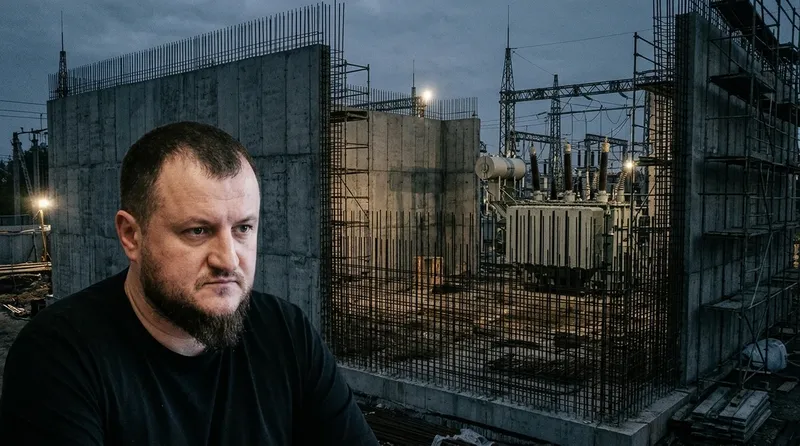
A Telegram channel claims that Kyiv Regional Council deputy Roman Bukovskyi is involved in the embezzlement of funds meant to protect infrastructure and is preparing to leave the country. Documents from the Verkhovna Rada investigative commission show a different route for the UAH 824 million in advances: from the Cabinet through the Kyiv regional military administration to the contractors.
Roman Bukovskyi, head of the Kyiv Regional Council's commission on capital construction, is trying to make sure the scandal over the money for protecting the region's infrastructure passes him by, writes Kompromat.leaks.
The accusation is serious, because it concerns money for protecting substations that have to survive this winter under "Shahed" strikes. Contractors received more than UAH 800 million to protect 26 substations, and not a single finished structure exists. The people responsible have been sought for several weeks, and until now every name in this story belonged to officials of the regional military administration and to contractors. The channel names a regional council deputy for the first time. To understand whether this version has any grounds, one has to follow the money: where it came from, who signed the contracts and where along the way Bukovskyi's commission could have stood.
What the channel claims
The channel's authors write that it was through the commission headed by Bukovskyi that millions for protecting infrastructure were channelled, and that they were later stolen. In their view, law enforcement should look not only at those who spent the budget money, but also at those who laid the financial routes for it.
The remaining accusations are even harsher. According to the channel, as soon as the scandal broke, the deputy began paying media outlets not to write about him, and is now making arrangements with law enforcement in advance. Separately, the channel cites an anonymous source in Bukovskyi's circle. This source claims that the deputy intends to leave for Montenegro, where he allegedly has a business, because his testimony would drag a whole chain of those involved down with him.
The channel offers no document to support any of these claims. It says that the media are reporting on the role of Bukovskyi's commission, but names no outlet. At the time this article was prepared, I could not find any publications linking Bukovskyi or his commission to the contracts for protecting substations. There is also no public reaction from Bukovskyi himself to the channel's post.
Where the money came from
The documents checked by the Verkhovna Rada temporary investigative commission on resilience plans describe an entirely different route. The head of this commission, MP Lesia Zaburanna, published the results of a treasury and engineering audit of 26 contracts. All of them were concluded by the regional development department of the Kyiv Regional Military Administration. They cover second-level protective structures at 110 kV substations, that is, concrete shelters around transformers that are supposed to withstand a Shahed hit.
The state provided the money for these structures. UAH 756.95 million, or about $16.7 million at the current exchange rate, came from the State Budget Reserve Fund. The region received another UAH 67.04 million, almost $1.5 million, as a subvention from the state budget. The Reserve Fund is managed by the Cabinet of Ministers, not by the regional council.
So on paper the route looks like this: the Cabinet allocates the money, the regional military administration concludes contracts through its department, and contractors receive advances. According to journalists' data, the contracts were signed by the director of the regional development department, Oleh Kravchenko. The regional council is absent from this chain.
Where the advances went
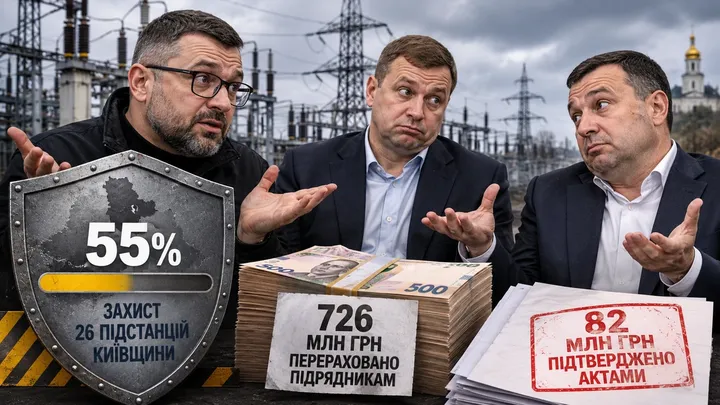
The contracts initially cost UAH 1.84 billion, or about $40.6 million. After the estimates were revised, the sum rose to UAH 2.28 billion, or roughly $50.3 million. Contractors have already received UAH 823.99 million in prepayment, about $18.2 million. Of that sum, only UAH 23.02 million, or 2.79%, has been closed by acceptance certificates for completed work. The region paid another UAH 87.45 million for work it accepted separately. So about UAH 801 million in advances, roughly $17.7 million, is still not confirmed by a single certificate.
Almost all the money went to two companies. LLC "Consulting-Bud" concluded 14 contracts worth UAH 926.85 million, received UAH 439.85 million in advances and confirmed UAH 15.48 million with completed work. LLC "UBK "Yu.Bi.Si."" concluded 9 contracts worth UAH 644.68 million, received UAH 324.8 million in advances and confirmed UAH 7.53 million. The same company acted as general designer of the documentation for all 26 sites, meaning it drew up the estimates on which it later built. The commission believes this needs to be checked for a conflict of interest.
MP Yaroslav Zheleznyak explains the link between the two contractors as follows. "Consulting-Bud" is owned by Liubomyra Kozhushko, and "Yu.Bi.Si." belongs to her partner Ihor Nesteruk. The regional military administration signed the first contract with "Consulting-Bud" on 8 April 2026. On 12 June Kozhushko was served a notice of suspicion in another case, but advances to her company kept arriving until October. Zheleznyak also drew attention to the estimates. Nine contracts have almost identical values, from UAH 60.05 million to UAH 68.54 million, although the sites are different. Imagine 12 different substations, for each of which the estimate provides for exactly 1,835.5 m of cable. In another 12 estimates, 51.5 m stands in the same way. By his calculations, the most expensive contract, worth UAH 89 million, provides for 5-6 times more reinforcing steel than is usually needed for that volume of concrete.
For comparison, the commission cited LLC "IZI Group". This company took a contract worth UAH 52.7 million with no advance at all and brought its site to a declared 56% readiness. In other words, it is possible to build without a large prepayment, and that is exactly why the advances to the other contractors raise so many questions.
There is also a figure in this story without any contract. Vladyslav Sokolov, a metal supplier from Dnipro, according to the police supplied materials through other firms, and investigators found a difference between the purchase and sale prices of the metal of roughly UAH 20.8 million. Sokolov himself claims that he was invited to cooperate by the former head of the regional military administration, Mykola Kalashnyk, and that the state owes him more than UAH 1 billion for work done without contracts. According to the Prosecutor General's Office, Sokolov has no suspect status, and the case has been handed to the SBU.
Who is responsible
Officials of the regional military administration are shifting responsibility onto one another. Mykola Kalashnyk, who headed the region until 16 July 2026 and then became a minister, says the contractors were chosen by the customer department. His former first deputy Ruslan Oliinyk claims the opposite: that Kalashnyk personally chose the contractors. On 9 November Oliinyk resigned as deputy minister after publications about his acquaintance with Sokolov. The current head of the regional military administration, Tymur Tkachenko, admitted that inspections showed unsatisfactory work: at some sites there were no workers.
Members of the Verkhovna Rada commission decided to appeal to the SBU, the State Bureau of Investigation and the National Police. MP Oleksii Kucherenko explained that the reports put the average readiness of the structures at 55%, but acceptance certificates have been provided for only 15% of their value. The completion deadline, 1 October 2026, was postponed three times, and the contractors have not kept to any new schedule.
Where Bukovskyi's commission could have stood
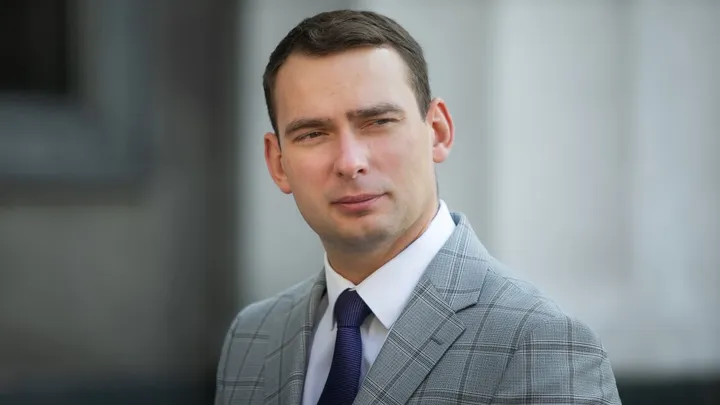
Bukovskyi is a member of the Servant of the People faction and heads the regional council's standing commission on capital construction, regional development, urban planning, transport, civil protection, and the restoration of housing and infrastructure facilities. In other words, construction, civil protection and the restoration of infrastructure all fall within the remit of his commission. So the question of what the regional council saw and did is logically addressed to him first.
However, a specialised commission does not control the money. It reviews draft decisions, regional programmes and budget amendments, and the session votes on them. The regional council does adopt its own programmes, including the programme for the resilience of life-support systems and critical infrastructure for 2023-2027. But the UAH 824 million in advances discussed in the commission's documents came from the state budget, not the regional one. So the channel's thesis about "financial routes" through Bukovskyi's commission can at most concern other, regional money for protecting infrastructure. Which money exactly this is, and what decisions his commission adopted, the channel does not explain.
Something else is interesting. When the scandal reached the national level, the investigation was taken up not by Bukovskyi's specialised commission. On 12 November the regional council created a separate temporary control commission that will examine the implementation of the resilience programme, the financing of the work and the readiness of communities for prolonged blackouts. The initiative was submitted by European Solidarity deputy Volodymyr Horkovenko, 57 deputies from all factions voted for it, and the commission was headed by his party colleague Roman Tytykalo. Horkovenko stated that some energy facilities did not receive a single hryvnia of the promised funding for their protection. Deputy Yaroslav Moskalenko explained that after the scandal began, communities started complaining about underfunding and unfinished construction on the part of the regional administration. That is, questions about the implementation of the resilience programme in the region had piled up long before the channel's post, and the initiative for the inquiry did not come from the commission headed by Bukovskyi.
Who Bukovskyi is
Bukovskyi came to the regional council in 2015 from the Opposition Bloc, for a district that includes Novi Petrivtsi, Stari Petrivtsi and Liutizh. According to data from the Chesno movement, he was 25th on the party's internal list at the time, and only 6 people from the party made it into the council, so he got his mandate after colleagues gave up their seats. At that time he headed the municipal football club Mezhyhirya and built housing. In 2017, according to the same movement's calculations, he missed 25% of plenary sessions. The same year he declared more than UAH 26 million, about $1 million at the exchange rate of the time, and became fourth in wealth among regional council deputies.
In 2019 Bukovskyi resigned his deputy powers early and ran for the Verkhovna Rada in District 96 in Vyshhorod, this time for Batkivshchyna, but lost. In 2020 he returned to the regional council, this time from Servant of the People, and later received the post of head of the capital construction commission. So in 5 years the deputy changed 3 political forces while keeping his interest in construction.
Little is publicly known about the business abroad to which the channel's anonymous source refers. As far back as 2024, there were publications saying that Bukovskyi owns property abroad and registers part of his assets in his parents' names. That same year, it was reported that the enforcement service had secured a temporary restriction on his leaving the country as a debtor. We were unable to find the court ruling on this restriction at the time of preparing this article, so it is not known whether it is still in force. If it is, the plan to leave for Montenegro that the channel writes about will not be easy to carry out.
What follows from this
The documents of the temporary investigative commission (TSK) answer the questions of who received the money and who signed the contracts: the regional development department of the regional military administration (OVA), its former leadership and two interconnected contractors. As for the role the regional council played in this story, there are no documents so far. The anonymous channel fills this void with an accusation against a specific deputy, but it does not show a single decision made by his committee.
Checking this version is easy, and no anonymous sources are needed for it. The temporary oversight commission of the regional council can pull the minutes of the capital construction committee for 2026 and find out whether it considered allocating funds for protecting energy facilities, to whom and how much. The law enforcement officers to whom the TSK has turned can put the same question to Bukovskyi himself. If there are no such decisions, the channel's post will remain yet another attempt to find a convenient culprit. If there are, then why has the committee chairman, whose powers include civil protection and the restoration of infrastructure, never once explained publicly that his committee knew about 26 unfinished shelters?
Source:Компромат.leaks
References:en.interfax.com.uakurs.com.ua